Thursday, May 24, 2012

Bermuda Bound on the Duchess of Devonshire

The following is an email I recently received from Ted Brewer. This isn't this month's "Question of the Month with Ted Brewer" post (that's coming next week!), but I found it to be an interesting story and thought I'd share it.

Email from Ted Brewer to SailFarLiveFree.com:

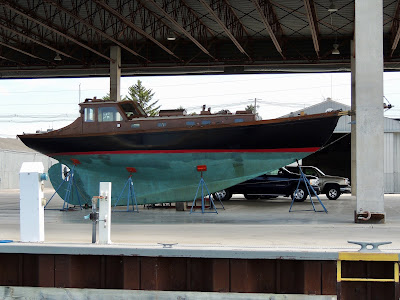
"Kevin, I just read your blog about the tragedy of Triple Stars and it really brought back some memories. In '64 I was working for Bill Luders and we had designed a steel 45 foot sloop, the Matinee, for a Connecticut owner. The yacht was built in Germany and, after he saw the drawings and the Matinee, Sir Bayard Dill of Bermuda ordered a sistership. Just like a lady, the Duchess of Devonshire was late in arriving and, by the time we offloaded her from the freighter in New York, towed her up to Luders Marine in Stamford, Connecticut and commissioned her, the autumn was well along. Indeed it was a cold and blustery day in early November before we sailed from the yard, with friends waving us a fond faretheewell, and began beating to windward along the Long Island shore, heading for Montauk Point. The merry crew consisted of Sir Bayard Dill, a friend of his, Sir Bayard's two grown sons, his sister, Alan MacDonald the shipyard rigger, and yours truly.

Unfortunately the weather gods were against us; the wind increased to near gale by noon and it began to snow, heavily. So discretion prevailed (or was it the mutinous, freezing crew?) and Sir Bayard decided to head back to Stamford to warm up and await a favourable forecast. That came along in a day or so and, again, we were underway but in far more pleasant weather. Montauk was rounded and we set course for Bermuda, hoping to get into the Gulf Stream and warmer weather in a couple of days. It was a happy ship though with Sir Bayard, Allen and I on the same watch, and Sir Bayard's sister dishing up hot and plentiful meals. I'm sorry I can't recall her name but she was a well known Broadway actress, and very pretty. That I do remember.

Sailing to Bermuda? Don't underestimate the passage
to this isolated island 500 miles offshore in the Atlantic.

We'd been out only 2 days when it began to blow and seas began creeping up from astern. We actually had a couple of birds land on the Duchess after being blown offshore, a sparrow and a small hawk which, eventually, attacked the sparrow. That took our minds off the weather for awhile but things were worse the next day with continuing near gale winds and high seas. Alan and I were on deck during the First Dog watch and the crew was below, with the companionway closed, having a Happy Hour. Alan was steering and I was in the port forward corner of the cockpit, taking things easy and watching sea after sea sweep up astern, to lift us up and pass beneath the hull. Then I noticed one spectacular sea, almost vertical, roaring up behind us. I yelled to Alan to hold on tight while I wrapped my arms around the jib sheet winch in a death grip, and we were pooped! Suddenly, Alan was in sea water to his chest while I, bent over the winch, was completely covered. The Duchess gave a bit of a roll then most of the briny was spilled out over the coaming, while the remainder drained through the scuppers.

Neither Alan nor I had a harness on, because no one had invented them yet, so we were lucky not to have been swept overboard. Also very lucky it had not happened at night, or I might not have seen that monster of a sea racing at us and shouted the warning. And lucky the companionway had been closed or the boat might have taken on a dangerous weight of sea water. Eventually, the rest of the crew spilled up from below and took over the watch while Alan and I nipped below to change into dry clothes and sip a couple of warming heart restorers.

There was some more excitement and troubles on that voyage but, eventually we landed safely in Bermuda, one day before they sent out the search planes! But that is another story!"

Tuesday, May 22, 2012

Water Wanderlust and the Cruiser's Spirit

"All journeys have secret destinations of which the traveler is unaware." - Martin Buber

Nicely said, Martin.  If I always knew the destination, the journey wouldn't be nearly as exciting.  I guess that means my answer is "no" to the age-old question of "Would you choose to know your future if it was possible?". What's your answer?

I've written plenty about why I sail, about having a cruiser's spirit, and about sailing induced self-reflection. Lately I've been pondering what it really means to be a cruiser and what drives a cruiser to sail on to the next anchorage or harbor. What is it that differentiates a cruising sailor from say, a racer or a liveaboard?  Racing sailors obviously love something about sailing, whether it be the mechanics or the competition. And those that call themselves liveaboards must also share my passion for a life in close connection with the water. But there's something that sets a cruiser apart. The best I can come up with today is water wanderlust

Here's what Merriam-Webster says about wanderlust - "wan-der-lust: (noun) strong longing for or impulse toward wandering"

Pretty simple, right? Plenty of folks have a strong longing to wander, travel and roam the Earth, or even just their own backyard. Cruising sailors have a specific kind of wanderlust, something I call water wanderlust.
Wandering beneath a rainbow somewhere on Lake Michigan (photo by K. Walters)
Many of my fondest memories and my largest personal growth has always come when I've been away from home. Whether it was childhood summer vacations spent in Maine, or winter vacations in Florida, or graduate school and the early days of my career in California, or even our honeymoon in the Dominican Republic, wandering far from the comforts and securities of home has enriched my life. Our summer spent cruising for nearly 3 consecutive months in 2010 opened my eyes to the fullfillment of submitting to water wanderlust. As this new sailing season kicks off, I'm anxiously awaiting new fullfillment from more summer cruises.

To close, I'll leave you with a quote from another of my favorite sailboat designers and a cruising icon, Bill Crealock, who once said...

"The journey itself should be one of the pleasures of the cruise."

Wednesday, May 16, 2012

A Sailor's Sole: Sailing Shoe Reviews

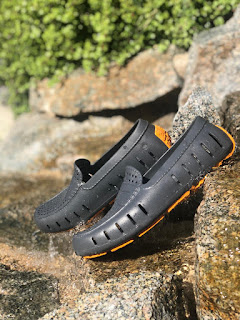
Whether you cruise on your sailboat, daysail or race, protecting your feet and having maximum grip on a wet deck should be on your priority list. Who among us sailors hasn't stubbed a toe on a deck cleat or stumbled on a slippery deck while going forward? I know some sailors who prefer bare feet while aboard, but I find that the right sailing shoes can prevent injury and mishaps while secondarily adding comfort and style. I've been sampling several shoes this spring that I think are all appropriate for sailing and boating. Have a read below and see which shoes might suit your needs.

From left to right: Fila, Keen, Merrell, Vibram


Keen Newport H2 ($100): By now everyone has seen Keen's Newport H2 sandals, as they're very popular both on the docks and on the trail. While some of this popularity undoubtedly comes from the Newport's classic good looks, I'm certain some of it has been earned through their rugged construction and wide range of uses. The footbed is called "Metatomical EVA" by Keen, but to me it's spongy rubber that provides comfort while resisting odor. Fabric footbed liners tend to soak up odor quickly in a sockless wet environment, so I really like the alternative material chosen by Keen. The upper webbing is polyester with "Aegis microbeshield", but again feels/looks like neoprene to my senses. The non-marking hard rubber sole features razor sipping and 3mm lugs. The sipping works well to provide very good wet traction on deck. The lugs are a bonus for shoreside hikes. While there are better boat-only shoes available, I think the Keen Newport H2 is the perfect balance for someone who wants versatile footwear at home, on the water and on the trail.

Pros: Rugged construction, breathable/airy sandal design, good blend of wet traction and onshore tread
Cons: Heavy, rigid sole may not provide enough "feel" underfoot for some people
Buy these shoes if: You're looking for a versatile, good looking sandal that can be worn on land or at sea


Fila Skele-Toes Bay Runner ($70): Vibram started the "barefoot" craze with their FiveFingers line of shoes a few years ago. Fila has recently joined this market with their own unique offering. Skele-Toes offer a pocketed glove-like fit, but unlike FiveFingers, the smallest two toes share a pocket and make putting Skele-Toes on your feet a bit easier. Another major difference is that Skele-Toes offer a much more rigid sole that doesn't allow your foot to flex as much. Depending on your preference, this may or may not be a good feature. The sole itself feels rugged and should offer good protection from deck hardware or rocks and other obstacles onshore. The tread pattern is the least innovative of any shoe in this review and doesn't offer sipping, but the wet traction still seems remarkably good in all but the wettest conditions. The bungee-toggle system makes tightening the Skele-Toes a cinch and the materials in the shoe's upper dries quickly when wet. These are very comfortable shoes that are lightweight and feel good on your feet.

Pros: Unique design, very comfortable, relatively affordable
Cons: Not the best wet traction, little arch support for those who need it
Buy these shoes if: You want a unique look, a good beach shoe, and don't require the very best wet traction


Merrell Barefoot Water Current Glove ($110): Merrell has taken a different approach to the barefoot craze than either FiveFingers or Skeletoes. Merrell's Barefoot line of footwear offers a minimalist shoe with a flat footbed, but no pocketed toes. The Water Current Glove (tested here) is extremely comfortable. This shoes is the closest I've come to feeling like I'm actually barefoot. The big keys for achieving this seem to be lightweight, a form-fitting upper, and a thin flexible sole. The synthetic leather and mesh upper on the Water Current Glove dries quickly and is so well done that you won't experience any hotspots or friction points. Water drainage is accomplished easily through both toe and heel ports. The footbed itself features Aegis antimicrobial technology and has not taken on any odor as of this writing. The Water Current Glove also features a high quality, non-marking Vibram sole with sipping that provides excellent wet and dry traction on deck. These shoes grip like Gorilla Glue!

Pros: Very comfortable, very lightweight, superior wet traction
Cons: Relatively expensive, flat sipped sole is not the best for hiking/land use
Buy these shoes if: You want the best wet traction and comfort available in a sailing shoe.


Vibram FiveFingers Classic ($75): This is the most unique and potentially "love it" or "hate it" shoe in my review. Vibram FiveFingers Classics are the shoe that likely started the "barefoot" trend. I've previously reviewed FiveFingers before, but it's interesting to try them out again in comparison with all of the above shoes. First, you'll notice FiveFingers are minimalist footwear with pockets for each of your ten toes. They're comfortable but a bit strange feeling at first. You'll need practice/patience to get use to putting them on. Once on, the fully sipped sole provides good grip on deck and exception "feel". These are very lightweight shoes with no arch support, so your feet will be tired when wearing them until your muscles and posture adjust. Although they do have anti-microbial insoles, I've found that odor can accumulate if your feet sweat a lot.

Pros: Very minimalist, good wet traction, excellent for feeling the deck beneath your feet
Cons: The fit/feel is not for everyone, lack of ventilation can mean hot/sweaty feet
Buy these shoes if: You enjoy sailing barefoot, but want added traction and protection for your feet. 


Conclusion: My go-to sailing shoes from the above list will likely be the Merrell's, but I honestly like each of the shoes in this review and enjoy having a variety of choices for different weather (cold, hot, rainy, etc.). To summarize, the Keen's are a good choice for dual purpose sailing/shore shoes; the Fila's are a great beach shoe; the Merrel's are an excellent all-around sailing shoe; and the Vibram's are good for those that would rather not wear shoes on a sailboat at all.

Saturday, May 12, 2012

Question of the Month with Designer Ted Brewer

I'm really excited to announce a new monthly series that will be appearing here on SailFarLiveFree.com called "Question of the Month with Designer Ted Brewer". Many of you are familiar with Ted and his sailboat designs and writing. For those that aren't familiar, you're in for a real treat! Ted has graciously agreed to be featured in my new monthly series where he will answer a sailing-related question (usually focused on design or Ted's experiences) that I present to him. Obviously I'm a big fan of Ted's work and have plenty of questions I'm eager to ask, but I'll also occasionally use questions submitted by you the readers here at Sail Far Live Free.  The first post in this series will appear in a week or so, but feel free to submit any questions/topics you may have for Ted to me via the comments below or email until then.

Ted at the drafting table
To whet your appetite, here's a bit of Ted's background in the form of a bio he sent me earlier this week:

Bio: Edward (Ted) Brewer

Ted was born in Hamilton, Ontario in 1933. He loved boats and learned to sail at the age of 13, but the Canadian Navy would not accept him on deck due to his wearing glasses, so he joined the Army instead. In late '56 he decided to return to his first love, boats, so he resigned his commission as Lieutenant and began work on the Weslawn Yacht Design course while awaiting his release. The army let him go the next spring and he was lucky to obtain a job as yacht broker with George Cuthbertson, who later founded C&C Yachts. Ted learned a great deal about design from George and, during the next 3 years, gained experience racing regularly aboard 8 meter yachts and sailing his own small boats up and down Lake Ontario.

Bill Luders was looking for a design assistant in the summer of '60 so Ted applied for the job, was accepted, moved to Connecticut and began work that September. While with Bill, he was involved with drawing up everything from 5.5 meter sloops (about 50 of them!) to 12 meter America's Cup racers, ocean racing yachts, cruising yachts and powerboats. Ted assisted in the modifications to Weatherly for the successful '62 Cup defense, did all the drawings for the Luders' designed 12 meter yacht American Eagle and, with Bill, supervised her construction. Ted also raced aboard Luders' swift and lovely 40' sloop Storm, and crewed aboard other Luders' designs on the Miami-Nassau, Annapolis-Newport and similar distance events.

In '67, Ted moved to Brooklin, Miane to hang out his shingle but still did all Luders' drafting, including the conversion of American Eagle to a very successful ocean racer, owned and skippered by Ted Turner (founder of CNN). In partnership with Bob Wallstrom, Ted produced over 100 custom and production designs from 18' catboats to the Whitby 42, the 56' aluminum ketch Mystic, the exquisite 62' ketch Traveller III and, going from the sublime to the ridiculous, a 64' three masted schooner approved by the USCG for daysailing with 125 passengers and crew. One of the yachts, the steel Huromic 35' Globe Star, circumnavigated in '81, skippered by Marvin Creamer, without the use of sextant, compass, or instruments of any kind except the owner's knowledge of winds and ocean currents' Then, in 2002, Ed Arnold solo'd an aluminum sistership, Nomad, around the globe, Sitka-Sitka, in 11 months. Interestingly, both of these adventurers made their voyages in the rough waters below Cape Horn, Cape of Good Hope and Australia, neither the easiest nor most comfortable course.

Brewer designed Schooner Tree of Life, named one
of the world's 100 finest yachts by SAIL Magazine
Over the years, Ted has raced and cruised in the waters from Hawaii (3 Trans-Pacs aboard Mystic), to the eastern Mediterranean, from the Caribbean to New England, and from the Great Lakes to the Pacific Northwest.

In 1999 Ted and his wife Betty returned to Canada and settled on Gabriola Island, British Columbia where he completed a few more designs, and donated his time, lecturing at Silva Bay Shipyard School. Finally, weary of ferry schedules and expense, they moved to Agassiz, BC in '06 where Ted still does some consulting and sells stock plans of his designs. In addition to completing over 270 designs, Ted has written for the major yachting magazines and completed 3 books; one of them, Understanding Boat Design (available for purchase from Amazon to the right),  has been a popular primer for over 40 years now.

Thursday, May 10, 2012

Gear Review: TaylorMade SuperGard Fenders

In a perfect cruiser's world, we'd all be either on passage or hanging out on the hook. Since we wouldn't be at the dock, there wouldn't be a need for fenders. But alas, being tied to one of the land's appendages is a reality we all face from time to time, and so I bring you a gear review featuring fenders.

You might think all boat fenders are created equal, that choosing a specific brand/model of fender is trivial. But I've used undersized fenders, fenders made from hard plastic, and fenders that abrade and pick-up dirt and grime that gets transferred to your hull. When a boat fender ceases to provide protection for your boat and sometimes causes direct damage to your boat, then the issue is no longer trivial.

TaylorMade SuperGard fenders guarding Island Bound's new polish & wax
I've recently switched my fenders to TaylorMade's SuperGard model. There are plenty of other choices on the market, many of which are cheaper, but you'll instantly be able to feel the quality difference when you hold one of the SuperGards. They are made from high quality marine-grade vinyl with a glossy finish but the sides are ribbed to prevent rolling and slipping along a dock or the side of your boat. There's an eye on both ends of the fender for attaching lines and enabling both a vertical and a horizontal placement if two lines are used. Other models feature a line hole running down the middle so that only one line is needed for horizontal placement, but I still prefer the SuperGard's twin eyes. The end caps and eyes are molded out of double thick black vinyl for extra strength. There's also a molded in air valve to allow you to adjust the inflation and "squishiness" of the fender. And in case you're style-conscious sailor, SuperGard fenders are available in a wide variety of colors to match nearly any boat, as evidenced by my new bright yellow fenders in the photo.

I highly recommend the SuperGards if you're looking for a high quality fender that will last many seasons and won't get easily damaged or cause damage if properly sized. I also have TaylorMade HullGard fenders, but they're now relegated to back-up/reserve status because I prefer the anti-roll qualities of the SuperGard's ribs.

Sunday, May 6, 2012

Go Small and Go Now! 5 Pocket Cruisers to Take you Anywhere

"Go small, go simple, go now!"
-Lin & Larry Pardey

Iconic cruisers Lin and Larry Pardey are well-known among cruising enthusiasts for the above statement. Can it really be that easy? Grab yourself a small boat, outfit it properly but simply for offshore work, and get going while your dream and your body is still alive! Lin and Larry not only made the statement, they lived it. If you're looking to do the same, maybe some of the micro- or pocket-cruisers I've listed below can serve as your "go small" portion of the equation.

Going small and choosing one of these or several other pocket cruisers will lead to trade-offs. Of course first and foremost you'll be giving up length, both on deck and at the waterline. This often leads to less storage space, less weight capacity, and slower sailing. But the upside is presumably less maintenance (less paint, less wood, fewer systems) and more affordable expenses. For example, replacing the sails or rigging on a 20 footer will be substantially less than doing so on a 45 footer. Furthermore, many boatyards and marinas charge by the foot for storage, dockage and labor. My point is, realize what the trade-offs are before investing in the "go small" mantra.

1. Flicka 20: When I first got into sailing I was drawn to the Flicka because of her diminuitive size, offshore reputation, and the intrepid sailors who choose her as their ticket to adventure. It seems there's always someone blogging an account of an epic journey aboard a Flicka 20. This little sailboat has so many bluewater passages, ocean crossings, and storm survival stories to her credit that it's truly hard to believe the spec sheet when you see her length on deck (LOD) listed at 20' and waterline length at 18'2". This offshore cruiser is tiny!
Look at that beautiful shape!
Designer Bruce Bingham was inspired to draw the Flicka 20's endearing shape by old wooden sailing workboats he saw in Rhode Island. He kept the size small in hopes of making the design an attractive option for cost conscious would-be home builders. A few of the plans sold and several homebuilt Flickas came to life in the early 1970's. Nor' Star Marine eventually purchased a Flicka hull plug and produced several boats through about 1977, many of which were finished off at home by buyers. Pacific Seacraft acquired the molds when Nor' Star went under and produced over 400 finished Flicka 20's.

Marquesas anyone? Flicka will get you there.
What I find most striking about the Flicka 20 is her seaworthy design, excellent construction (PSC versions), and the amazingly roomy accomadations that will have you thinking you're aboard at least a 25 footer when you see the cabin. At 6,000 lbs., Flicka is also heavier than many cruisers nearly 10 feet longer. She reportedly will make 4-5 knots and can handle some really nasty conditions with a competent helmsman. You won't find a saltier looking boat at any size, let alone something under 25 feet. If you're the type of person (like me!) who can happily spend hours just staring at a salty boat and who tends to make several glances back at your own boat as you leave the dock because you simply can't resist, the Flicka will warm your heart. Knowing that she can take you safely around the world is just another perk. A quick look at Yachtworld.com reveals 5 Flicka's available for purchase from $20k-$30k (at the time of this posting), but prices are often much higher for those with offshore gear (windvane steering, etc.) and a trailer. Visit the excellent Flicka20.com owner's site for much more information.

2. Allegra 24: If you like the Flicka, you'll find an additional 4 feet of Flicka-inspired length to like on the Allegra 24. The Allegra looks a lot like the Flicka. This is not by happenstance, as one of the Allegra co-designers happens to be Bruce Bingham's father. The Allegra design keeps the Flicka's beam but stretches her length so more deck, cabin, and waterline length are available.  Of course this translates to more creature comforts, more storage, and more sailing speed. Many Allegra sailors attest that this boat can fairly easily exceed her hullspeed.

Allegra 24 w/ cutter rig
While Allegra was sold as both a bare hull (for home builders) and as a kit that could be completed by any number of yards/builders on a custom basis, there are many finely finished examples out cruising the seas. This isn't always the case with home-built or kit boats. I think the level of finish on the Allegra's I've seen for sale is a testment to their owner's passion. Yachtworld only shows one Allegra currently on the market. Her asking price is $48k. [Note: I almost included the Pacific Sea Craft Dana 24 in this list, but decided against it since PSC was already represented w/ the Flicka and the Allegra is similar. Still, it's worth your time to check out the Dana if you like this style of boat.]

3. Tom Thumb 24: The Tom Thumb 24 may well be the most interesting boat on this list, which is a true feat considering the unique niche that most of these pocket cruisers occupy. At first glance, the Tom Thumb 24 looks a lot like the Flicka or Allegra. But look close at those hard chines and you'll realize she's made of steel. Of course steel sailboats aren't all that uncommon, but finding one this small definately is. Conventional steel boat design would have many believing a 24-footer would be too heavy. That's where ingenious designer Grahame Shannon and monocoque construction comes in. Grahame designed the Tom Thumb 24 to be built frameless and instead use interior plywood furniture for stiffening structures. This is a common constuction technique with modern fiberglass boats, but steel boats typically have a heavy steel frame inside. Grahame's frameless steel skin and wood cabin kept the design light enough to actually sail quite well. You can still purchase the design plans for your own Tom Thumb 24 (or larger!) today from Bruce Roberts Yacht Design and be cruising in a truly unique boat tomorrow.

Tom Thumb 24 slicing through chop
4. Nor'Sea 27: The Nor'Sea 27 is the largest boat on my list, so what's so "pocket" about this pocket cruiser? Consider that one day the Nor'Sea 27 can depart the middle of the United States and be ripping down the interstate at 55mph (on a trailer, of course) and the next she can be headed offshore from San Diego harbor enroute to the Marquesas thousands of miles away. This bluewater sailboat was conceived from the beginning as a trailer-sailer. Designer Lyle Hess was challenged to build a trailerable bluewater boat and he delivered. Hess is quoted as saying; "Any boat that points her bow out to sea should be designed so that the crew need not worry about a safe return - no matter what tricks the weather may play". And so it is with the Nor'Sea 27. If that isn't enough lure, take a peak below decks and you'll see fine craftsmanship and very cruiser-friendly layouts. She's available in both aft and centercockpit configurations with lots of space and plenty of berths. Center cockpits usually look funky in small sailboats, but amazingly Hess makes the Nor'Sea 27 gorgeous in addition to being trailerable and bluewater capable. What's the trade-off? Price. New complete boats are still available from Nor'Sea for about $170k, but they've been in production since 1977 so the pre-owned market is an option with prices starting in the $30k's.

Center cockpit Nor'Sea 27
5. Falmouth Cutter 22: I find it fitting that a bluewater pocket cruiser takes its' name from one of the deepest natural harbors in the world, a harbor that is also famous for being the starting point of Francis Chichester's epic circumnavigation and the homeport of Charles Darwin's HMS Beagle. It takes a very big small sailboat to live up to the Falmouth name, but the Falmouth Cutter 22 does so and then some. Maybe this shouldn't come as a surprise since the Falmouth Cutter was designed by Lyle Hess, the designer of the Nor'Sea 27 above and the better known Bristol Channel Cutter 28.

Falmouth Cutter 22 in action
Inspired by 19th century working pilot boats who's primary purpose was to carry heavy loads in just about any sea condition, Hess drew the FC22 with historically beautiful looks and a hull shape that's proven itself for more than 100 years. This boat is old world seaworthiness and charm meets modern construction techniques and building materials. She's got a good turn of speed considering her short waterline. And like the old pilot boats that use to ply the waters of the North Sea, she'll make sure her crew makes it home through gale and hail. My favorite feature may well be that the FC22 is extremely accommodating down below for an ambitious cruising couple or a solo sailor.  

Are you sold on the FC22? Get ready to pay the price for true love, because it doesn't come cheap. While the Falmouth Cutter was originally built by the well-respected Sam L. Morse Co. in California, she's now available as new construction from Cape George Marine Works in Washington for around $175k.  Yes, you read that right...$175k for a 22 foot sailboat!  If that's above your budget but you're still smitten, you can try the brokerage market on Yachtworld where two early 1980's FC22's are currently available for about $50k. No matter your choice of new or used, Lin and Larry Pardey's very similar Hess-designed 24 footer Seraffyn has proven that this an extremely capable pocket yacht for satisfying the most ambitious cruising plans.

So there you have it, 5 little yachts that can take on the world or simply draw admiration and longing stares at your local dock. As you can see in most of the examples above, a small cruising sailboat doesn't necessarily equate with a small purchase price. These are little boats for living large on a giant ocean. If you're hoping to spend time cruising or crossing a giant ocean but don't have the budget for one of these pocket cruisers, stayed tuned as I'll soon be posting about potential bluewater boats for those on a shoestring budget.

Wednesday, May 2, 2012

Launch Day

The day has come, the season is here;
Boatyards are bustling, winter covers disappear.

Just enough time for wax and paint;
Soon there will be trips to places far and quaint.

But first, there's oil to be changed;
There's storage and gear to be rearranged.

Don't forget to check batteries, plugs, and seacocks;
Sand out, dry and fill those blistering pox.

Bring aboard canvas, cushions, and sails;
Soon water will be rushing past the rails.

Diesel smoke, clackety-clack and more loud sound;
The travel lift is on its' way to awaken s/v Island Bound.

Up she rises, off the jack stands in a flash;
To the launch basin and finally...SPLASH!

Launch Day 2012: I couldn't be happier!

Monday, April 30, 2012

Captain Dad

"If the highest aim of a captain were to preserve his ship, he would keep it in port forever."
-St. Thomas Aquinas

What makes a good ship's captain? Is it someone who leads fearlessly in times of duress? Is it someone who knows all the USCG boating "rules of the road"? Maybe it has more to do with making a crew add up to more than the sum of their individual parts. Is a good captain someone with limitless courage? Or maybe the best captains are those that realize their fear is their only real courage?

Sometimes the roles of captain and dad converge
Since becoming a father to our third daughter in March, I've been thinking about how fatherhood feels a lot like being a ship captain. We as individual family members represent the crew, while collectively our family of 5 represents the ship. And just like ships on the sea, families on the sea of life need leadership, guidance and a cohesive crew. As if fatherhood didn't have enough responsibility, I've now gone and added a responsibility laden analogy.

St. Thomas Aquinas in the quote at the beginning of this post is right; captains are indeed responsible for the safety of the crew and ship, but not at the total expense of finding adventure and completing a mission. As a father I strive to bring my family adventures from which we can grow by being challenged. Family cruising on a small sailboat brings both adventure and challenges in spades. Safety is a priority, but our sailboat and our figurative family "ship" often leaves port in less than ideal conditions.

Like most sailing ships and sailboats, families are more seaworthy and able to weather storms better than their individual crew members. If you sail you've probably heard it said that the boat can handle much worse weather than you can. And so it is with our family. I'm constantly reminded of how resilient and strong we are as a family unit. I don't always make the best decisions as Captain Dad and maybe my 9 year old can be a bit mutinous at times, but together as a family we always make it through both the rough seas and the doldrums.

Captain and crew
Families, like ships, need good navigation and a sense of direction from the captain. We don't necessarily always need to know where we're going, but we certainly need to know which troubled waters to avoid. I do my best to plot a cruising course that keeps us off the reefs and a family course that keeps us clear of the nasty things that can tear a family apart (selfishness, greed, divorce, etc.).

Being a captain comes with trade-offs. Sometimes the captain has to make decisions that aren't popular among the crew, but are indeed in their best interest. The ability and confidence to make these decisions ideally comes from experience and sometimes, if we captains are fortunate, from wisdom too. Luckily I've got the best admiral on the seas helping me command our ship. Of course I'm referring to my wife, who is every bit the competent parent and sailor that I believe myself to be. Together we understand that both our family and our little ship need love and dedication or pieces will begin to rot and deteriorate from neglect.

The Admiral and crew
So maybe this whole "Captain Dad" analogy is just me trying to put myself on a sailboat in my day-to-day life as a parent, even if only figuratively sometimes. But I can honestly say that self-reflection like this makes me both a better dad and a better sailor.

Tuesday, April 24, 2012

Tragedy at Sea: Triple Stars and the 2011 NARC

"The sea's rules can be ignored only at real, physical peril, not at mere risk of social or financial penalty."
-Tom Wicker from Rough Passage

Sometimes being an aspiring blogger comes with the unfortunate consequence of reporting and editorializing heart wrenching stories. That's the case today as I write about the tragedy in the latest North American Rally to the Caribbean (NARC). Many bloggers and media outlets already reported on the sad story of the cruising vessel Triple Stars back in November of 2011. I refrained from blogging about the event at the time because I felt the story was well covered, and frankly, too sad to write about at the time. Now that time has passed and new details related to the story have surfaced, I feel compelled to share the tragedy of Triple Stars here on my blog today.

For those unfamiliar with the NARC, it's one of several cruising sailboat rallies that groups several boats together for a passage from the mainland United States to the Caribbean. The advantages of such a rally are many including camaraderie, safety in numbers, an organized passage, free weather routing, and many social events. The 2011 NARC departed Newport, Rhode Island for the island of St. Martin on November 1st with a fleet of 22 sailboats ranging from a 36-foot Columbia to an Oyster 56. The event is not a race, but rather a passage made together by a fleet in communication with each other throughout.

Rob Anderson and his wife Jan had been cruising together since 2007. They were experienced cruisers looking forward to a winter spent in the Caribbean aboard their Island Packet 38 cutter. The 2011 NARC was their ticket to the islands. Shortly after receiving an EPRIB notification on November 11, 2011, the U.S. Coast Guard received a radio distress report from Rob aboard the sailing vessel Triple Stars stating that his wife had been washed overboard by a 30-foot wave. The USCG then reported they were searching the Atlantic Ocean 285 miles northwest of Bermuda for an overboard sailor. At approximately 5 p.m. on November 11, the merchant vessel High Jumper evacuated Rob from Triple Stars and continued the search for Jan. Neither High Jumper, the USCG, nor the rally fleet were able to locate Jan. She was lost at sea.

Autopilot malfunctions and a problem with the mainsail onboard Triple Stars may have contributed to the tragedy. But more assuredly, the stormy conditions near Bermuda (possibly combined with the aforementioned issues?) were to blame. Rob Anderson later told the USCG: "We were hit by a 30-foot wave. My wife went through the bimini top and I saw her floundering in the water. There were 25-foot seas and I threw her a life ring which she grabbed onto, but when I brought the boat around, I saw her go under and not resurface." Based on the research I've done, I don't believe Jan was tethered to Triple Stars, though I do think they had jacklines, harnesses and tethers available as required to participate in the NARC.

So what are the new details about the story that have recently come to light? A Holland America cruise ship (Prisendam) spotted the abandoned Triple Stars adrift in the Atlantic on March 14, 2012. Reportedly, the captain had the cruise ship do a slow circle around the ill-fated Island Packet and sounded the ship's horn to no response. Radio communications with the Bermuda Coast Guard confirmed that Triple Stars was known to be abandoned and adrift.

Triple Stars as seen from the
Holland America cruise ship on March 14
Remarkably, Triple Stars seems to have weathered the storms and time alone at sea very well. I don't know her ultimate fate, but I'm guessing Rob Anderson would have very mixed emotions about recovering and repossessing his vessel. Maybe he's already settled with his insurance company and Triple Stars has been written off.

Both my mom and mother-in-law read this blog, so there's risk to my future cruising aspirations in me bringing such sailing tragedy to light. I'm not sure what to make of this whole story. It's sad and difficult to write about. But I think there are important lessons to be learned. Not so much lessons that lay blame on the Anderson's actions, but lessons that remind me how the cruising life is much more serious than just palm trees and martinis.

You can read the Anderson's logs just days prior to the tragedy on their blog.

Saturday, April 21, 2012

Gear Review: Telescope for iPad

Apple's iPad is quickly becoming a very versatile onboard tool able to serve up the functions of several more traditional pieces of boat gear and marine electronics. While I've highlighted many of my favorite iPad apps and uses for sailing, I haven't yet blogged about useful iPad accessories for boating and sailing. Enter the iPad 2 Telescope from Brando, an iPad add-on that extends the viewing range of the built-in camera. The telescope accessory comes with a special iPad backplate and attachable lens. The lens adds 6X optical zoom capabilities and features manual focus by rotating the bezel.
iPad 2 Telescope accessory

Why on Earth would you want a telescope accessory for your iPad? Theoretically, the iPad telescope could serve as a back-up to your binoculars, which should be in every cruiser's inventory for making landfall, spotting ships, reading navigational aids, and much more. But don't go dumping your expensive Fujinons just yet.

iPad 2 Telescope accessory
The telescope accessory is very simple to use. Just attached the lens to the backplate and then snap the backplate on your iPad. Keep in mind, the back plate only fits iPad2 (not the original iPad or the "new iPad"). If you have an Apple SmartCover, you'll need to remove it before attaching the backplate as the two are not compatible.

How about the optics? Well, as I mentioned above, the telescope adds 6X optical power to the iPad's built-in camera lens. The iPad's "pinch to zoom" function adds increased power, but via digital zoom only and therefore increases pixelation and decreases image quality. I've posted some pictures I took yesterday at the end of this post so you can see the different variations in image quality and zoom produced with and without the telescope.

The iPad telescope accessory is fun but only marginally useful for boaters/sailors. First, having to snap on the backplate every time you want to use it is a minor inconvenience. Second, the telescopic lens protruding from the back of the iPad could potentially get knocked or dinged if you're not careful. Of course the iPad nor the telescope are weatherproof, so you can only use them in good conditions. Lastly, the iPad2's rear camera, while better than the front facing VGA camera, is still only 1MP so image quality is limited by default. If Brando decides to offer a backplate that fits the "new iPad", then image quality would be improved with the new iPad's 5MP rear camera. In most cases, I think using the iPad as a giant point-and-shoot camera looks silly, but in the case of the telescope it's actually really nice to have a 9.5" screen to see what's in the viewfinder.

The telescope accessory won't replace my binoculars and probably won't get all that much use onboard, but for around $26 I think it's a well-made and fun accessory to mess around with improve one of the iPad2's biggest weaknesses: the camera.  

Picture taken with iPad2 only (telescope accessory NOT attached)

Picture taken with iPad2 w/ telescope accessory (6X)

Picture taken with iPad2 w/ telescope accessory & full iPad digital zoom

iPad2 Telescope Accessory Review Summary

Pros: affordable, well-made, simple

Cons: limited by iPad2's camera specs, not ideal for marine environment

Bottom Line: A fun accessory that improves the iPad2's camera lens and usability.

Wednesday, April 18, 2012

Around the Americas

I've blogged before about the recent slough of record attempting voyages aboard sailboats. While I applaud the courage, endurance, and state of mind required to make some of these attempts, I'm not personally inspired to break any records or create a media splash. I quite simply hope to Sail Far and Live Free. I do, however, find some of the current record voyages and hype worth mentioning.

One such voyage I did find interesting and worthwhile was that of the Around the Americas (ATA) expedition.  During 2009/2010, the crew of s/v Ocean Watch sailed her 25,000 miles literally all the way around both North and South America with the mission of inspiring, educating, and engaging citizens of the Americas to protect our fragile oceans. A worthy cause, right? My former life as a marine biologist has me believing so.

s/v Ocean Watch with her goal printed on the big spinnaker
The Around the Americas expedition raised awareness for an important issue with an engaging website, excellent crew logs, fabulous pictures, educational shoreside seminars, and a hoard media coverage. A crew of four sailing a steel-hulled 64' vessel all the way around two continents, including a passage of Cape Horn and a challenging route through polar ice north of Canada, for a worthy cause is notable. But this blog post isn't about the ATA expedition.

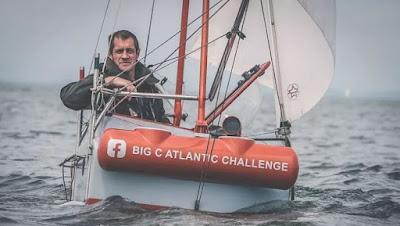
This post is about another expedition around the Americas. An important difference: This time the crew consists of a solo sailor, a VERY modest 27' fiberglass sailboat, and another very worthy cause. Meet Matt Rutherford, a sailor taking his 1970's era Albin Vega non-stop (yes, non-stop!) around the Americas, including an east-to-west transit of the icy Northwest Passage. Matt is using his remarkable voyage to raise money for Chesapeake Regional Accessible Boating (CRAB), a non-profit organization dedicated to making the thrill of sailing a reality for those with physical and mental disabilities.

So can he make it all the way around both continents solo in such a small boat? If you've been following this story, you know that Matt is very near the end of his journey and is about to cross over his outbound track anytime between now and Saturday. Yes, he will indeed be the first to circumnavigate the Americas single-handed. You can see Matt's progress and watch him finish his expedition here on his website.

Rutherford nearing the end of his journey off of Virginia
My Mt. Gay Rum Regatta hat goes off to these two sailing expeditions that have shown us a lot about what it means to Sail Far and Live Free.

Saturday, April 14, 2012

The Best Sailing Songs You've Never Heard

You know this voice,
but do you know the ones below?
Jimmy Buffett has made a fortune over the years singing his nautical rhymes that give voice to many a cruising sailor. You know (and perhaps love) all of his sailing songs like Son of a Sailor and A Pirate Looks at Forty. But what about those smaller grassroots artists who also express the passion and beauty of sailing through song? I've found several that have inspired me to Sail Far and Live Free. They've earned their megabytes on my iPod through well written lyrics and "feel good" melodies. If you're looking for new tunes to echo across the water this summer, check out the songs/artists below.

FREE by Jack Maynard
"Serendipity sat in the boat boneyard with a broken mast and a broken heart. I think it was fate or my destiny. Did I choose you or did you choose me? We wanted to sail on the wind and the sea, over the rails on a hard-a-lee, take it off, leave it off, play in the sun, set our sails for a downwind run..."

Bienvenidos Summer Wind by Jack Maynard
"Bienvendios summer wind, sail me away on journey back in time to yesterday. Take me down to the ocean, ride the waves once more. See the beautiful faces on the American shore. Feel those misty kisses dance freely again. Breathe the air of peace and love, summer wind."

Sailing Away by David Cisco
"Set the sail, loose bow, we're shoving off shore right now. Bring all hands on deck. This is a moment you won't forget. I don't know why, but it happens ever time I feel the waves below me. It's as if the water knows me. Wind and sun in my face. Oh it is a time, it is a place when I feel at my best. Yeah, I'll solve some problems, forget the rest."

Jiggy by David Cisco
"I've ridden the waves forty foot high and forty foot come crashin' down! I steered through the rain for days and days never knowing I was just going 'round and 'round. You can stay safe in the harbor, you can stay safe close to shore, but that my son wouldn't be much fun and that ain't what ships are built for!"

Latitudes & Attitudes by Eric Stone
"Smooth seas and blue skies, palms trees and sunshine await me in new latitudes. Pirates and treasure. Ordeal or adventure, the only difference is attitude. So I'll raise me glass and raise the sails, toast the world from the bow. Say farewell to my landlocked life, throwin' in the towel. Wherever my journey takes me, I'll take time to unwind because paradise is not a place, it's state of mind. And my mind is made up, I'm gonna sail away."

Sailing Life by Eric Stone
"I got a magnetic fix on my compass, a true northern girl on my starboard. She moved down here to escape from the snow. We met on a beach by the harbor. We filled the 'reefer with lobster and beer and now we're leavin' slip. We might be slow, but on island time the journey itself is what makes the trip. Sailing life is what I chose."  

Last of the Leelanau Schooners by Michael Snell
"With a half empty hold and leaks 'round the seams, don't let her fall off, keep the waves of the beam. But she'll bring them all safely back home as she's done without fail. She's the last of the Leelanau schooners to ever set sail."

The Land of the Inland Seas by Michael Snell
"North and south and west to east your waters sing to me a soothing song to hush the rush of this life I choose to lead. So take a look around you, take in all you see. This funny shape within these lakes is all the home we'll ever need. Oh Michigan, the land of the inland seas."

Monday, April 9, 2012

What's in a name? (My thoughts on boat names)

"What's in a name? That which we call a boat by any other name would sail as sweet."
-my adaptation from William Shakespeare's Romeo and Juliet

It's no secret that many of us feel a very personal connection to our boats. They have personalities and character that often reflect their owner's good and bad attributes. When I read the name on a boat I often wonder what the inspiration was. Other times I simply wonder, "What were they thinking!?" Evidently, sometimes they weren't thinking at all. There are quirky boat names like the sailboat called Hot Ruddered Bum. Others are strangely embarrassing like the powerboat I saw named Helmroid. And some make you think a bit before you get the name, like Never Again II.

BoatUS releases a "top ten most popular boat names" list every year based on orders they receive for vinyl boat name graphics. Usually the names aren't all that imaginative, as you might expect from some of the most common names. In any case, here's their 2011 list of most popular boat names:

10. Blew ByYou
9. Miss Behavin'
8. Liquid Asset
7. Second Wind
6. Serenity Now
5. Pegasus
4. Dream Weaver
3. Aquaholic
2. Nauti Buoy
1. Seas the Day

See? Nothing too terribly creative or memorable, but nothing really offensive either. Maybe BoatUS graciously censors the list so we don't see a sailboat called Bow Movement, or a yacht called Ship for Brains or a dinghy called Myasis Dragon anywhere in the top ten. Here's a few other names that make me smile, but will never grace the transom of any boat I'll ever own: Maid of Plywood (for the wooden boat aficionado), Harvey Wharfbanger (for those who chose to dock the boat after too many cocktails), Bimini Cricket (for the Disney fans out there), and Sail Bad the Sinner (for those wannabe pirates who don't know how to trim the main).

And then there's Donna Lange's little Southern Cross 28 named Inspired Insanity that she sailed around the world.  At first read, the name doesn't come off as anything too special. But then consider that Donna lists Inspired Insanity as hailing from the Virgin Islands. And then when you see it pictured, the canoe-stern of her sailboat plays a funny little trick with the name. See for yourself in the picture below.

Inspired Insanity from the Virgin Islands
or
Inspired Virgin from the Insanity Islands?
Ever get annoyed with the corporate world plastering their names on stuff that already had a cool name to begin with? This is all too common among pro sports venues. Remember Candlestick Park in San Francisco, home of the NFL 49ers and MLB Giants? Today it's known as "AT&T Park". How about historic Tiger Stadium in Detroit? The stadium is now rubble and has conveniently been replaced by "Comerica Park", in case you go to a summer ballgame to forget the frigid economy. The same plight has fallen on the America's Cup sailboats. There was a time when classics yachts like Intrepid, Resolute, and Enterprise held the cup. Nowadays, you'll find names like BMW Oracle Racing USA-17 in the record books.


How about my own boat? She's named Island Bound, the name she came with when we purchased her. I like the name even though it's a bit cliche and plain. It still manages to warm my skin and focus my goals on turquoise anchorages in the lee of some palm covered beach. But maybe you're not so fortunate as me and you dislike the name that came with your boat. Don't change it on a whim! You'll need ceremony and ritual to ward off the bad luck that superstitious sailors work hard to avoid. The best renaming ceremony I've come across is this one from John Vigor. There are others, but be prepared to come up with multiple virgins and other odd and/or hard to find components!

Ok, enough of me blathering, venting and just generally carrying on about boat names that have caught my eye over the years. The take-home message from this blog post is my advice for naming boats. So here goes:

1. Does your boat's name have special meaning to you? I think it should. For example, a fishing boat named Reel Obsession conveys the passions of the captain.

2. Don't forget you'll have to repeat the name publicly over VHF for communications, and potentially repeat it several times for a "Mayday" call. Imagine the channel 16 chatter of these two boats: "ShipFaced, ShipFaced, ShipFaced, this is the sailing vessel Makin' Luff..."

3. Is your boat's name unique? Really, how many boats named Dot Calm or Happy Ours do we need roaming the seas? Newsflash: Using "Nauti" in the name (eg. Nauti Boyz, Feelin' Nauti, Reel Nauti, etc.) is no longer original (see the #2 BoatUS name above).

4. Don't forget about irony. I have a sneaking suspicion that boats with names like Money Pit and B.O.A.T. (Bring On Another Thousand) will soon be paying for an expensive blister repair job or the full replacement of canvas lost to a freak wind storm. 

5. Does your boat's name leave you feeling inspired, proud, and in love? Mine does.

Monday, March 26, 2012

Top 10 Favorite Affordable Bluewater Sailboats

I've always said that my favorite boat is whichever one I currently own. Being able to call it "mine" makes it my favorite by default. My first boat was a $400 derelict that I loved (still love) deeply. And she loved me back. However, that doesn't mean there aren't other boats I love that I'd like to call "mine" someday. In honor of March and tournament time (any bball fans out there?), I thought I'd put together my personal ranking of my favorite affordable (available for ~$50k) sailboats. I've rather arbitrarily set the price limit around $50k and called it "affordable" in hopes that one day one of these boats might fit my budget and help my family and I to sail far and live free. Also note that other than the top 3, these rankings change in my head almost daily and I really struggled to narrow the list down to just 10.  

As you peruse my list, you'll notice that they're all bluewater cruisers. You won't find any modern designs, fin keels, spade rudders, sugar scoop transoms, carbon fiber rigs, or plumb bows. What you will find are long keels, heavy displacements, tons of teak (Since I don't own them yet I don't have to varnish them!), many canoe sterns, and salty good looks. It's a shame that very few of today's manufacturers build a salty looking sailboat with true offshore abilitiy in a small, affordable package. Luckily I'm proud to be smitten by the treasures of a bygone era. As always, feel free to share your thoughts and your own list of favorites or others you think I should add to mine.

Top Ten Affordable Bluewater Cruisers (according to SailFarLiveFree.com)

10. CSY 33: With a production run of only 57 boats, it's not surprising that many people aren't familiar with CSY's smallest sailboat. Her swoopy sheerline and sharp bow beckon me.  And just in case you thought all those new fancy deck saloon (DS) designs from the likes of Jeanneau were new and novel ideas, just remember that CSY built this little 33 footer way back in 1978.
CSY 33
9. Shannon 28: Walt Schulz, Shannon 28 designer and Shannon Yachts founder, has since moved on to bigger and more modern yachts like the Shannon 53HPS. But I think he did his finest work with the Shannon 28, just the second model ever offered from Shannon. She's the smallest boat on my list, but was just too seaworthy and beautiful to leave off the list. I love the reverse transom and transom-hung rudder.  And have you seen Shannon's craftsmenship? Just in case you think 28 feet is too few to offer any choice in cabin layout, Shannon gave you three options with names that speak of this boat's purpose: Passagemaker Layout, Cruising Layout, Offshore Layout.

Shannon 28 s/v Peace, completing a single handed transatlantic crossing
8. Valiant 32: How far into this list did you think you'd get without running into a Bob Perry designed boat? This one is like a mini-Valiant 40, which is one of the most well-known and proven offshore boats and a member of the American Sailboat Hall of Fame. Just like the 40, Perry designed the 32 to have classic looks you'd expect from a 1970's era world cruiser (canoe stern, etc.) but with a more modern underbody. She's got a long modified keel approaching the look of a fin keel with a skeg hung rudder. The Valiant 32 delivers vintage double-ender aesthetics without the sometimes sluggish sailing of a fullkeel.
Valiant 32
7. Fuji 35: There's just something about a clipper bow and a ketch rig that magically transports my mind to the South Pacific. And if you're going to make the long sail to the South Pacific, you might as well be coddled in a gorgeously warm and wood filled cabin like that of the Fuji 35. The Fuji 35 was also available with a cutter rig, but it looks perfectly balanced to my eye with a mizzen mast.
Welcome home (Fuji 35 cabin)
6. Alajuela 38: At first glance and without knowing the length, it might be easy to confuse the Alajuela 38 with the Westsail 32. But I assure you, she's a different animal.  She's really a closer cousin to the Ingrid 38, which I would have included if it weren't so similar. Have you ever seen a longer keel than that on the Alajuela 38? I bet she tracks like a freight train. And how about that massive rudder? This boat is the very definition of a "stout cruiser".
Alajuela 38

5. Tayana 37: The Tayana 37 is the second Perry-designed boat to make my list, and deservedly so as many far-flung anchorages around the globe have hosted a T37. This boat is in many ways Bob's answer to the Westsail 32 phenonom of the 1970's. While Bob Perry himself thought the ketch option added speed and balance, I like the look of the more common Tayana 37 cutter. There were a lot of these beauties produced (~650) so finding one with a price and configuration to your likely shouldn't be a problem. Heck, there's a even a pilothouse version for those who sail in cooler climates.

Tayana 37
4. Pacific Seacraft Mariah 31: Here's another boat that seems to be a response to the Westsail 32. Pacific Seacraft (now under new ownership) still produces some very desirable bluewater cruisers today, but the Mariah (not to be confused w/ the current PSC 31)  is vastly different than her modern day siblings. Pacific Seacraft co-founder and Mariah designer Henry Morschadt put together what was known in the 1970's as "the most expensive boat of its size" but now represents somewhat of a bluewater bargain. Even today the Mariah is still thought of as one of the best built, sturdiest bluewater boats around. This reputation is largely due to the 3 inch hull thickness at the bilge and 1 inch thickness above the waterline. If you've ever replaced a thru-hull fitting on your own boat, you'll understand that 3 inches of fiberglass is insanely thick. No one wants to run aground, but you couldn't find a boat better built to take a hit with her full keel, transom hung rudder, prop aperture, and that thick hull.

A good look at Mariah 31's transom hung rudder
3. Westsail 32: This boat is already legendary in this blog post, let alone to the cruising community. In 1973, Time Magazine ran a feature about the cruising life with accompanying photos of a Westsail 32 somewhere over the horizon. The Westsail Corporation smartly coined the phrase "Westsail the World" and the cruising boom was on. If you dreamed of remote palm-covered islands and had the gumption to act on your vision, the Westsail 32 was your ticket to paradise. The Westsail's design pedigree is strong with the likes of William Atkin taking credit for the hull's inspiration and William Crealock (of Pacific Seacraft fame) getting credit for the deck design and layout. This is the Tiger Woods of cruising sailboats: You either love the Westsail 32 or hate it. Many criticize it for being unnecessarily slow and heavy, mocking it with the "wet-snail 32" moniker. But I dare say Westsail fans far outnumber the critics. The 32's seakeeping abilities, strong construction, and reputation for safe passages is nearly unmatched. Remember the movie The Perfect Storm? If you recall, there's a brief mention in the movie of a true story about a sailboat that was caught in that perfect storm, yet somehow survived after being abandoned by her crew. That boat was the sailing vessel Satori. Check out the real U.S. Coast Guard footage of Satori in the perfect storm here:


Westsail 32 off Northern California

2. Baba 30: You guessed it, another Bob Perry design. I promise I'm not on Bob's payroll. I just can't resist his double-ender designs (see Bob's guest post on my blog here). The canoe stern, deckhouse, bowsprit and long keel are SO perfectly balanced. Whenever I see a Baba on the water or at the dock, I can't turn away. The Baba 30 is very nearly my perfect boat. She's drop-dead gorgeous inside and out. She's built tough as nails. She sails very well. She's "affordable". So why isn't the Baba 30 number 1 on my list? I'm a realist and if this is suppose to be a list of boats I might one day actually own, well then I'm gonna need more cabin space for those cruises when my then grown daughters come to visit mom and dad. The Baba 30 is really a couple's boat, not necessarily a family boat. Of course there's always the very similar looking Baba 35 or Baba 40, but now we've officially left the land of "affordable" bluewater boating.

My kind of math: Baba 30 + tanbark sails = boat porn

1. Han Christian 33 Traditional: This is the way a boat should look; like it's ready to take on the world and be your steady dance partner even in the sloppiest of seas. Remember the almost perfect Baba 30 above? The Hans Christian 33 Traditional sails in and adds to all that I love about the Baba with the addition of a very family friendly and liveable cabin layout. The HC33t features what amounts to luxury accommodations for an affordable bluewater cruiser. The forward cabin features a head, sink and full stall shower in the forepeak. That's followed immediately by a pullman berth (perfect for moms and dads!). The salon is just as functional and well thought out. Dedicated nav station? Check. Dinette with seating for 5? Check. Functional and sea-safe galley? Check. Fully enclosed aft stateroom with sleeping for 2? Check. All of this is presented with typical Hans Christian curves carved from hardwoods. On the outside she looks like a massive ocean canoe or Viking ship with a snooty bow and squat stern. The massive bowsprit supports the headsail, leaving room on the bow for the staysail. And look at those shin-high bulwarks around the rail! The underbody is equally beautiful. It features a long full keel with a cut-away forefoot and a fully protected prop and rudder. I dream about this boat. This boat has literally appeared in my day and night dreams multiple times. And I'm pretty sure the latitude on the GPS read 0 in every one of them.

So functional, so beautiful!
HC33t coming at you
HC33t sailing far, living free!