Thursday, December 29, 2011

Welcome the Wind

Much has already been written about the wind.  One of my favorite wind quotes is from William Arthur Ward who said, "The pessimist complains about the wind; the optimist expects it to change; the realist adjusts the sails."

And another from Captain Christopher Shelton (from s/v Albatross and the movie White Squall): "You can't run from the wind.  You trim your sails, face the music, and keep going."

So now allow me to write a bit more about the wind, for sailing would be a lot more like drifting without it.  There are a few things in life that we can't see even with our eyes wide open.  God.  Love.  And the wind.  We can see the effects of all these things, but we can't see the actual thing.  However, if we allow our other senses to open up, we can feel them.  It amazes me that something as cryptic as the wind has the ability to carry a sailboat thousands and thousands of miles.

And lastly, I'll finish my tribute to the wind with the lyrics to Windsong from one of my favorite musicians, John Denver.

The Wind is the whisper of our mother the earthThe Wind is the hand of our father the skyThe Wind watches over our struggles and pleasuresThe Wind is the goddess who first learned to fly

The Wind is the bearer of bad and good tidingsWeaver of darkness, bringer of dawnThe Wind gives the rain, then builds us a rainbowThe Wind is the singer who sang the first song

Wind is a twister of anger and warningThe Wind brings the fragrance of freshly mown hayThe Wind is a racer and wild stallion runningAnd the sweet taste of love on a slow summer’s day

The Wind knows the songs of cities and canyonsThunder of mountains, roar of the seaWind is the taker and giver of morningsThe Wind is the symbol of all that is free

So, welcome the Wind and the wisdom she offersFollow her summons when she calls againIn your heart and your spirit, let the breezes surround youLift up your voice then and sing with the Wind

Monday, December 26, 2011

Double Enders According to Perry (Guest Post by Bob Perry)


WestMarine.com


Have you ever wondered why many classic bluewater sailboats are double enders?  Is there something inherent in the double ender design that makes them particularly well suited for offshore work?  Or maybe you're like me and simply find them to be irresistibly good looking and aspire to own one regardless of the design's intended function.  I'm pleased to welcome a very special guest blogger to SailFarLiveFree.com.  Bob Perry, one of the world's foremost yacht designers and a double ender aficionado, has graciously agreed to share his thoughts on my blog.  For more of Bob's writing, visit Yacht Design According to Perry.  What follows are Bob's words...

Oh boy. I get to write on someone else’s blog. I think I will write about double enders as a subject in itself. Without bragging too much I think I might  be responsible for more double enders on the water than any other designer. I don’t have a  total number but it has to be close to 1,500 boats maybe more. I know double enders. I have always been drawn to double enders from the time I was 15 years old. I used to walk from our house on Mercer Island, across the floating bridge and down to Lake Union where I would sit and dream, aboard a converted Bristol Bay fishing boat they had for sale at Vesoga’s brokerage. I was 15 and there was no way I could buy the boat but I could dream.
I was lucky as a kid in that I became aware of Bill Garden’s design early on. Bill did some great double enders. Some were based on the Colin Archer style and some in Bill’s unique way were straight from Mars. Walking the docks one day at Shilshole Bay Marina I was stopped dead in my tracks by a long, skinny, light green boat that looked like no other boat in the marina. I knew I was looking at a very special boat but I had no idea what it was. It was OCEANUS, Bill’s own boat. In time I would get to crew on OCEANUS for local races. I loved that boat. I also learned about and studied the double enders of William Atkin. His ERIC was a favorite of mine. One of the very first boats I drew hull lines for was a 32’ double ender I called BUDDY after Bud Stantorf, the man who really taught me how to sail. He died when I was 16. The Albert Strange canoe yawls remain some of my all time favorites.

Baba 30 in Scotland
Years later, with the IOR making people angry, a reactionary movement sprung up in the cruising community. Heavy, slow, salty, Colin Archer type double enders propelled by the Westsail movement were the accepted boats for offshore cruising. For some reason double enders were seen as safer offshore boats. This probably came from the Colin Archer lifeboat tradition. But there were all sorts of strange theories as to why the double ender was the best hull form for offshore. “The stern parts the following seas.” I call this the “Moses effect”. Maybe the stern parts the following sea because there is not enough buoyancy aft for the stern to rise to the following sea. “There is more reserve buoyancy aft.” This is certainly not true in a boat like a Westsail with almost no stern overhang at all. There is almost no buoyancy aft. Ok, fine, what about a canoe stern? Yes, a canoe stern can give you far more buoyancy aft than a Westsail type stern but a nice broad transom stern with some overhang will have far more buoyancy aft than a canoe stern.  “In a double ender the heeled waterlines are more balanced.” Yes, in most cases this is true and it’s a good thing but I’m not certain it makes a boat more seaworthy or sea kindly. It does make some boats easier to balance over a wide range of heel angles.
Then why did I make the Valiant 40 a double ender? Marketing! It was just assumed that offshore cruising boats had to be double enders and rather than buck that trend I decided to go with it and at the same time add my own twist to the shape to try and improve the performance of the double ender.
Baba 40
The stern shape I used for the Valiant 40, 32 and 47,  Esprit 37, Tayana 37 ( they built over 600 of these), Hans Christian 34 ( my step child the HC 36 aka Union Polaris 36,  Mao Ta 36, et al), Polaris 43, the Baba 30, 35and 40, the Tashiba 31, and 36 was what I began to call a “tumblehome canoe stern”. I got the idea for this shape from a K. Aage Nielsen design, HOLGER DANSK. “Tumblehome” because the way the stern profile rolls back forward at the top.  I think K. Aage got the idea from a number of Scandinavian designers and you could probably trace the origins of the basic tumblehome stern profile back to the Viking ships. I didn’t “invent” anything. I will take credit for combining some basic design elements into a new combination to try to bring the double ender up to date with modern designs. But Skip Calkins had done this earlier with his spectacular Calkins 50 double ender. Garden had tried to do it with OCEANUS but as much as I revered Bill and loved OCEANUS it really had a weird shape below the DWL and a strange distribution of volume. Aesthetically I found OCEANUS hard to beat but on the race course an 8 meter could beat us boat for boat. The Valiant used the midsection of an IOR two tonner with a sensible skeg hung rudder and one of the first NACA foil section keels ever seen on a cruising boat. My other double enders were mostly full keel boats but again I tried to do what I could to bring their performance level up.
Lafitte on a beam reach
I remember sitting at dinner one night with the Lafitte group who built the Lafitte 44. At the other end of the dining table I could hear a discussion going on about the benefits of the canoe stern. I thought to myself, “What BS.” If any boat is going to spend it’s life moving forward the best way to end the boat is with a transom. The bow and the stern do very different jobs. The stern should not look like the bow. I don’t think there really is a cogent argument for why double enders are the best sea boats. But if you insist on sailing around in reverse I think a double ender makes the most sense.
Sawyer 42
But I still like double enders. I’m working on a new 62’ double ender right now. This is the 62’ SLIVER and it is a marvelous, long and skinny double ended sled being built now in Hadlock. I just like the look. Years ago YACHTING Magazine wanted me to come over to their mag and write their design reviews. I was happy at SAILING but YACHTING offered me twice the money. I said I’d think about it. They said why don’t you try a test article to see if we can work together. I decided to write an article on double enders. I decided to interview a few other designers for the article and get their thoughts on  double enders. I asked each one, “Why is a double ender better?” They all said it wasn’t better than a transom sterned boat. All except Bill Crealock who said the double ender was better but when I asked why he couldn’t  or wouldn’t tell me. I also asked these designers what kind of boats they personally sailed. All but one sailed a double ender. I had an El Toro pram at the time so I considered that a double  ender. The bow looked like the stern.

Baba 30 in slings
I am often thought of as primarily a designer of double enders. That’s OK. At least I am thought of. The Valiant 40 did get me into the first 15 people inducted into CRUISING WORLD’s Hall of Fame. That made me feel really good. But if you look at my entire body of work I have designed far more transom sterned boats than double enders. For a wide variety of reasons a transom works best. But if I sat down this afternoon to design a new boat just for me there is absolutely no doubt it would be a double ender.
I always thought my Esprit 37 RICKY NELSON had the prettiest fanny in any anchorage.

Sunday, December 18, 2011

The Christmas Tree Ship

Lake Michigan was not feeling the Christmas spirit in November of 1912.  The big lake wasn’t giving any gifts that year, but rather was taking ships and crew to her cold depths.  Captain Herman Schuenemann knew the Great Lakes could get ornery in November, for it was in November of 1898 that his brother August was lost forever when his schooner sank in a storm near Glencoe, Illinois while attempting to deliver Christmas trees to Chicago.  August had asked Herman to join him on the ill-fated voyage, but he declined after proudly telling August that his wife was giving birth to twin daughters.  After August’s death, Herman was undaunted and carried on in the family Christmas tree business. 

Herman Schuenemann became beloved by Chicago residents for brining fresh cut Christmas trees from Michigan’s Upper Peninsula aboard sailing vessels to Chicago.  Each year the arrival of his ship in port near the Clark Street Bridge would signify the official start of the holiday season.  He spread good cheer to everyone who came to the dock to get their family tree.  You couldn’t help but feel jolly looking at the Christmas lights adorning his ship and the tree set atop the main mast.  Children were so enamored that they believed Captain Schuennemann came directly from the North Pole with his evergreen trees.  His ship became known as the “Christmas Tree Ship” and he “Captain Santa”.  Over the years, Captain Santa and the Christmas Tree Ship became as much a part of a Chicago Christmas as did the release of the Sears and Roebuck Catalog.

Rouse Simmons under sail
By November 22, 1912, Captain Schuennemann and his crew of lumberjack-sailors had loaded around 5,500 trees aboard the 123 foot three-masted schooner Rouse Simmons, better known as the Christmas Tree Ship (Note: Schuenemann actually commanded several schooners that carried Christmas tress as cargo to Chicago, but the Rouse Simmons was the last.).  They were in Thompson Harbor near Manistique, Michigan in northern Lake Michigan.  Several other ships in the area were postponing the sail down Lake Michigan because of stormy weather.  Captain Schuennemann must have thought carefully about his departure window.  Interestingly, some of the crew also had thoughts about the timing of the departure.  Several claimed to have seen rats leaving the Rouse Simmons recently, which is a bad omen obvious to even non-sailors.  Others may have been put off by the plan to leave on November 22…a Friday.  Superstitious sailors never start a voyage on a Friday.  So some of the crew, Afdtterby omen or by luck, ended up taking a train back to Chicago.  Nevertheless, Captain Schuennemann and his remaining crew (of an unverified number) put to the inland sea on the evening of Friday, November 22, 1912. 

When the Christmas tree ship and crew reached the base of Wisconsin’s Door County peninsula near Kewaunee during the afternoon of November 23, they were spotted by the watchman at the Life-Saving Station (pre-cursor to the U.S. Coast Guard).  The Captain of the station reported in a phone call to the Two Rivers station that the ship was flying its flag at half-mast, a universal sign of distress.  The stricken schooner was “under short sails heading south and under a good headway...”.  After the Life Saving Station further south at Two Rivers was notified, a search and possible rescue was attempted in a power lifeboat, but was unable to locate any sign of the Rouse Simmons.  No one ever saw the ship, crew or Captain Santa again.

Rouse Simmons as she lays today
(photo by Tamara Thomsen/Wisconsin Historical Society)
Twelve years later in 1924, Captain Schuenemann’s wallet was brought up from the depths of the big lake wrapped in oilskin when it became tangled in a fishing net.  Their was initially a report of a distress message from the crew found in a bottle a few weeks after the storm, but many believe it to be a cruel hoax.  There are also stories of a second message in a bottle, but again opinions on the validity differ.   It was not until 1971 that the wreck of the Rouse Simmons itself was finally located.  Legendary Great Lakes diver Gordon Kent Bellrichard found her resting upright and largely intact on the bottom in 172 feet of water off Two Rivers, Wisconsin.  Evergreen trees can still be seen on her decks and in her holds today.  A survey of the wreck showed that the ship’s wheel was missing.  It was recovered, again in a fishing net, in the 1990’s.  Damage to the wheel lead some to speculate that the mizzen boom may have collapsed and broken the wheel off of the ship.  This may explain why the Rouse Simmons didn’t seem to make any effort to make safe harbor at Kewaunee or Two Rivers when she was spotted by the Life Saving Station.  However, a 2006 technical field report from the Wisconsin Historical Society offers good evidence that the wheel may have actually been torn from the ship by fishing nets years after the Rouse Simmons sank.  Interestingly, the report also indicates that the crew had actually deployed the port anchor in nearly 165 feet of water shortly before the ship sank.  The wreck's current orientation has the bow facing the direction of the wind on the night of the storm. (I highly recommend reading the above mentioned report if you're at all interested in the the wreck of the Rouse Simmons).

Tree atop mast of s/v Friends Good Will
in South Haven, MI (photo by K. Walters)
Captain Schuenemann’s widow and children diligently continued to keep the family Christmas tree business alive in Chicago for many years after the family’s second shipwreck tragedy.  The first municipal Christmas tree and lighting ceremony in Chicago were held in December of 1912 in Captain Schuenemann’s honor.  Even now, the U.S. Coast Guard cutter Mackinaw and servicemen commemorate the Schuenemann Christmas Tree Ship legacy each year by delivering trees to needy families in Chicago.

While the above words are my rendition of this story told to the best of my ability, I have to thank author Rochelle Pennington for the inspiration to write this post.  I recently saw Rochelle speak at the Michigan Maritime Museum in South Haven, Michigan and found her telling of the story and display of artifacts recovered from the Rouse Simmons to be fascinating.  There are many more details which I didn’t have space for in my post, but are masterfully put to print in Rochelle’s two books about the Christmas Tree Ship.  I also wish to thank Tamara Thomsen of the Wisconsin Historical Society for providing factual and historical edits to my original post.  For me personally, the story of Captain Santa and the Christmas Tree Ship is a favorite, even if it is filled with tragedy.  The Schuenemann’s spirit is inspiring.  The power of the Great Lakes is daunting.  The lore of the inland seas is ever captivating. 

Wednesday, December 14, 2011

From the Great Lakes to Great Escapes: Live Free (guest post)

Lake Michigan is my home water.  My cruising roots have been fertilized and grown here on the Great Lakes.  I feel a connection with Great Lakes sailors and have a bit of a quest to heighten awareness for the Great Lakes and raise their profile among sailors, outdoor enthusiasts and those with an intrinsic passion for water.  I believe those who have never been on the Great Lakes would be in awe of their size and beauty.  It is in this vein that I plan to periodically host guest blog posts authored by cruising sailors who started their great escape in the Great Lakes.

Brittany and Scott from Windtraveler started their journey at the southern end of Lake Michigan in Chicago back in September, 2011 (although planning, dreaming and scheming occurred long before).  Today they've made it as far south as Grenada in the Caribbean.  Given the theme of my website (Sail Far, Live Free!), I thought their blog post titled "Live Free" was a good fit and actually reminds me very much of my own Why I Sail post.  The post below was written by Brittany and first appeared on their blog here.  (Thank you Brittany for allowing me to use your post!)

Live Free! (by Brittany Meyers)

We've been asked so many questions during this short visit home: what's your favorite place?  Your scariest moment?  Your favorite dish? ... the list goes on.  But the most interesting question, perhaps, came from a very good friend of ours when he asked: "What is the biggest lesson you learned so far?"

I actually had to think about that one.  Anyone who has read our blog for any length of time knows that the lessons learned through this "journey" are great and vast. We have learned so much about ourselves, about life, about nature, about the universe...it's incredible, really.

So what is the greatest lesson we have learned?

After some thought, I finally answered: "I think the biggest thing I have learned is that - once you get away from land, once you shove off and are free from societal contraints - anything is possible".

Does that make sense?

Because it's true.  The minute Scott and I said goodbye to Chicago an entire world opened up to us.  Not just the physical world, but the figurative world as well; the world of opportunity.  We were now in a world where we were able to dream...and not only could we dream, but we could do so freely and without doubt. Suddenly, it was not insane to imagine opening up a tiny marina in some tropical isle, or running a charter company in the Caribbean, or opening a hostel for wayward travelers or running a boutique sandwich shop in the islands...suddenly all those things that on land seemed silly and fruitless, held weight and possibility.  It's amazing to be thirty-two and still be dreaming what life will be like when I "grow up".  I mean, I am just getting started!

I don't know what it will take for you to see your dreams as something more, but you should do it.  It is an incredibly freeing way to live.  Scott and I feel like kids in a candy store who found a ten dollar bill on the floor.  It's like nobody knows our secret, yet it's so simple and easy.  How come we have this ten dollars when so many people don't?  There really is power in dreaming.  There really is another way to live.  There really is a way to live a life less ordinary.  You just need to step aside and extricate yourself from the status quo, it's designed to keep you there!  Easier for some than for others, for sure.  But I am a firm believer that where there is a will, there is a way.

And that is the best lesson of all; we have learned what it feels like to be free!

Tuesday, December 13, 2011

Update: Best Apps for Sailing and Boating


WestMarine.com


Just a quick update to let readers know I've made two new additions to the Best Apps for Sailing and Boating blog post.  You'll now find the Star Walk and Cruisers Forum apps included in the list.  I'll periodically continue to add new sailing apps as they become available and I have a chance to review them.

Friday, December 9, 2011

A New Home Port!

Notice anything new about the blog/website?  I started blogging back in 2007 on SailBlogs.com and fairly quickly moved over to Google's Blogger.  I can humbly say that the site has grown, matured, and increased in readership.  Now that my blog is nearly five years old, I thought it was a good time to freshen things up with a new look, layout, features and name.

Let's start with the name.  Most of you will know that I have used "Sailing Island Bound" for several years, with Blogger's default domain name of http://www.sailislandbound.blogspot.com/.  Since the site has transformed into much more than just the chronicles of Island Bound's journeys, I've choosen a new name that reflects my own personal journey and hopefully inspires my readers...Sail Far, Live Free!  So now I've got my own domain/URL, which is http://www.sailfarlivefree.com/.  Don't worry, your old bookmarks and links to the blogspot address will still work too, but updating is recommended.

You'll also notice hotlinks to new pages just under the Sail Far Live Free header.  These will allow you easy access to categorized postings and content I've written over the years.  You'll find pages such as "About", "Ponderings", "Gear Reviews", etc.  I figured adding these pages was a good way to keep my hard work from getting lost in the blog archives.

So take a tour through the website and feel free to provide feedback via email or comments on this post.  If you haven't subscribed yet, you can follow SailFarLiveFree.com using the email box to the left or by using the "Subscribe to Our Blog" options further below.  As the new welcome message to the left says, "Stay awhile and read, dream, and be inspired to Sail Far, Live Free!"

YURBHSDU6VKB

Tuesday, December 6, 2011

Ghosts of the Great Lakes

Every year or so, a new lost shipwreck is discovered somewhere in the Great Lakes.  Many are remarkably well preserved because of the cold, freshwater in the Great Lakes.  With literally thousands of ships lost (some estimate as many as 8,000) in the inland seas, it's likely this trend of discovery will continue.  Perhaps the most coveted and yet to be discovered lost shipwreck in the Great Lakes is that of Le Griffon.

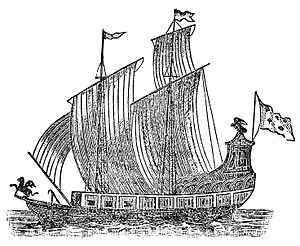
Le Griffon was a French barque ( or "bark", referring to the rig which consists of multiple masts, fore-and-aft sails on the aftermost mast and square sails on all other masts) commanded by famed French explorer Robert de LaSalle.  She displaced around 40 tons and was likely only 30 to 40 feet long.  LaSalle was seeking a Northwest Passage to China for France.  Le Griffon was launched in 1679 by LaSalle as a way to control the fur trade with Native Americans in the Great Lakes region.  Le Griffon may very well be the first “ship” to have sailed on the Great Lakes by some criteria (decking, permanent masts, bearing a name).

Surprisingly, Le Griffon disappeared on the return trip from her maiden voyage.  The ship left her birth place on the Niagara River in July of 1679.  She made her way into Lake Erie and on through the St. Clair River into lower Lake Huron.  After weathering an August gale on Lake Huron, Le Griffon and crew made port at Mackinac Island.  They pushed on, likely to Washington Island at the mouth of Green Bay, where they met up with Pottawatomies and fur traders that La Salle had sent ahead to begin trading.  La Salle stayed behind as he ordered the crew to take the newly acquired furs back to Mackinac Island aboard Le Griffon.  After holding up near Washington Island in Lake Michigan while waiting out another big storm, Le Griffon departed on September 18, 1679 to drop furs at Mackinac and make her way back to the Niagara River. 

The ill-fated ship and crew were never heard from again.  While some theories suggest foul play amongst the Pottawatomies may have led to her disappearance, a more likely scenario is that Le Griffon was lost in the stormy waters of the Straits of Mackinac.  Historical records indicate a storm did occur shortly after Le Griffon set sail from Washington Island.  A third scenario that La Salle himself considered after hearing rumors amongst the Native Americans was that the crew of Le Giffon scuttled her and ran off with the furs.  No matter the true story, many shipwreck hunters have searched for the missing ship ever since.

It’s not uncommon for Great Lakes shipwrecks to go un-identified after they’ve been found and there are at least a few that may indeed be Le Griffon.  There are unidentified wrecks off the western end of Manitoulin Island in Lake Huron and another off of Escanaba in Lake Michigan that have archeologists, shipwreck hunters and historians digging for more clues.  The most promising find is a wreck discovered in 2001 at an undisclosed location by the Great Lakes Exploration Group.  In late 2010, GLEG released a press statement announcing an ongoing assessment of the site and a cooperative agreement between GLEG, the State of Michigan and France that describes the process for documenting and identifying the suspected shipwreck.  The agreement stipulates that the investigation must be completed by January of 2012, so we soon may finally have a conclusion to the final chapter of Le Griffon’s story.